This year – 2026 – at work, I reached a milestone anniversary of 15 years. This entitled me to take advantage of Bank of America’s sabbatical program, which gives you two chunks of paid vacation time on your 5n-year work anniversaries starting with 15 years and then each 5 years after that. You can take two of these sabbaticals within your career with the Bank. Since I might die tomorrow, I decided to take my 15 year sabbatical which gives me 4 weeks of paid time off.
As for what to do with that time, I wanted to spend some of it cycling. I couldn’t do a 4-week cycling trip. Er, I could, but my wife would kill me with a young daughter at home and me absent in the care-giving for her. I figured a week was a reasonable ask, and I could tack my trip together with a family vacation for another week. That would consume about half of my sabbatical time, and I could figure out a use for the remainder of the time.
The Background
I did a bikepacking trip along the C&O trail back in 2024, on the tail end of my paternity leave when my daughter was born. That trip spanned 4 days. One day of transit NJ-to-DC plus riding, then 2 more riding days, then a train trip back from Cumberland to DC to NJ. All in it was ~150 miles, and zero elevation since I followed an old canal path. So I had some experience cycling, camping, then cycling again the next day. But not a ton. And I did this C&O trip on a steel-framed Kona with lots of storage; Ortlieb panniers front and rear, maybe 60-80L of storage in total.
This trip I would plan for 2026 would be longer. It would involving climbing hills. So I had to re-think my bike choice, my packing and gear choices, and my daily mileage goals. To keep everything within a 7-10 window and to give my family a palatable vacation option at the end of the trip, I chose the VTXL. A route which passes through the entire heart of Vermont, from south-west tip to north-east tip.
The choice of Vermont was easy. I spent many childhood vacations there, so I knew I could convince my wife and my parents to join the post-ride vacation. I had spent years prior to tearing my ACL skiing in the town of Stowe, Vermont making the convincing of a few friends to join easy. And I genuinely loved the green mountain state.
The route, the VTXL, is ideal for adventure. It’s a mostly-gravel path, it covers an entire state, and it has plenty of small towns and camping options. While this bikepacking trip would be harder than my C&O trip, it wouldn’t be such a jump in difficulty that I would have to dramatically change my life to fit it in.
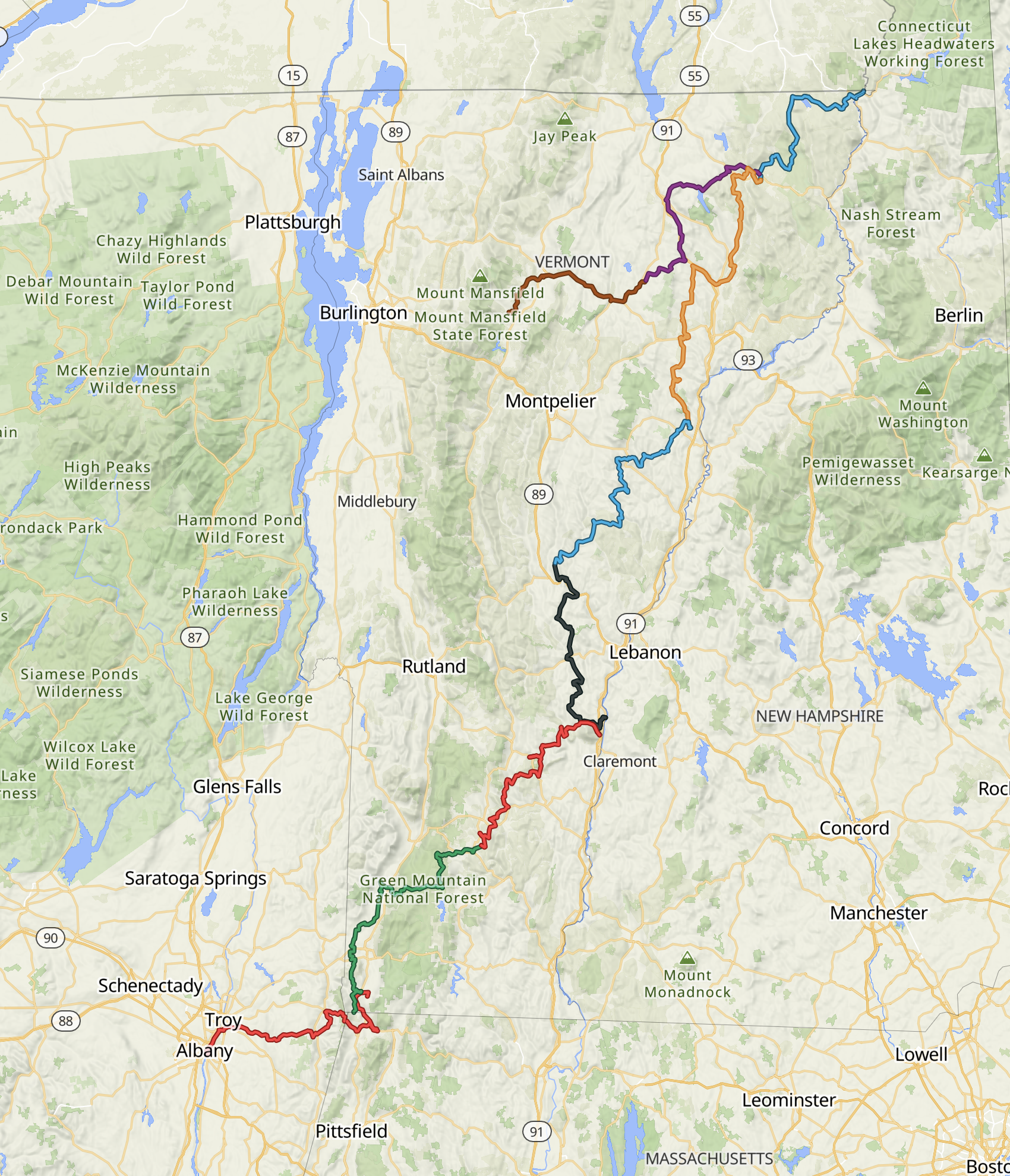
My own take on the VTXL route, starting in Albany, NY and ending in Stowe, VT.
The Bike
I briefly considered using the Kona Sutra I had taken on the C&O trip, but a couple things held me back. First, while I think bar-end shifters are neat-o, I didn’t want to spend a lot of time climbing hills with them. I wanted something more modern. Second, I didn’t love the bike fit position I had on that bike. With the popular ascendancy of gravel riding, I wanted a new bike that could serve my needs for this trip while also getting me into the world of gravel.
That bike was Rodeo Lab’s Traildonkey. I still need to write up my experience buying and breaking in that bike, but suffice for now to say that when I finally had it I fell in love. I knew it would be a good companion for my VTXL dreams. The main reason I selected this bike was the company’s ethos, the positive reviews I read online, and the option to get external cable routing direct from the builder (which makes maintenance simpler).
I spent the fall of 2025 exploring my new steed, finding out what I needed to add to it, getting the fit dialed in, and connecting emotionally to it. When you ride a bike for 3 hours, it can be anything that doesn’t make you bleed. You only need to survive. And when you plan to ride a bike for 7-10 days, it really helps if you love it. So I set about finding that love for the Traildonkey.
I did a few local gravel rides, found the right saddle, and by the winter of 2025 I knew this thing could carry me 300 miles across the state of Vermont. I realized I would need better climbing gear ratios, so about a month before I set off on my trip I swapped the 42T front chainring over to a 36T. This gave me a 36/52 ratio (0.692) which equates to about 20 gear-inches. For this much gear and my own level of fitness and climbing 15%+ gradients I prboably would have done better at 16-18 gear-inches. Save that knowledge for the next one. (Although I’ll need a different drivetrain, as this is the smallest ratio I can get with a SRAM mullet setup.)
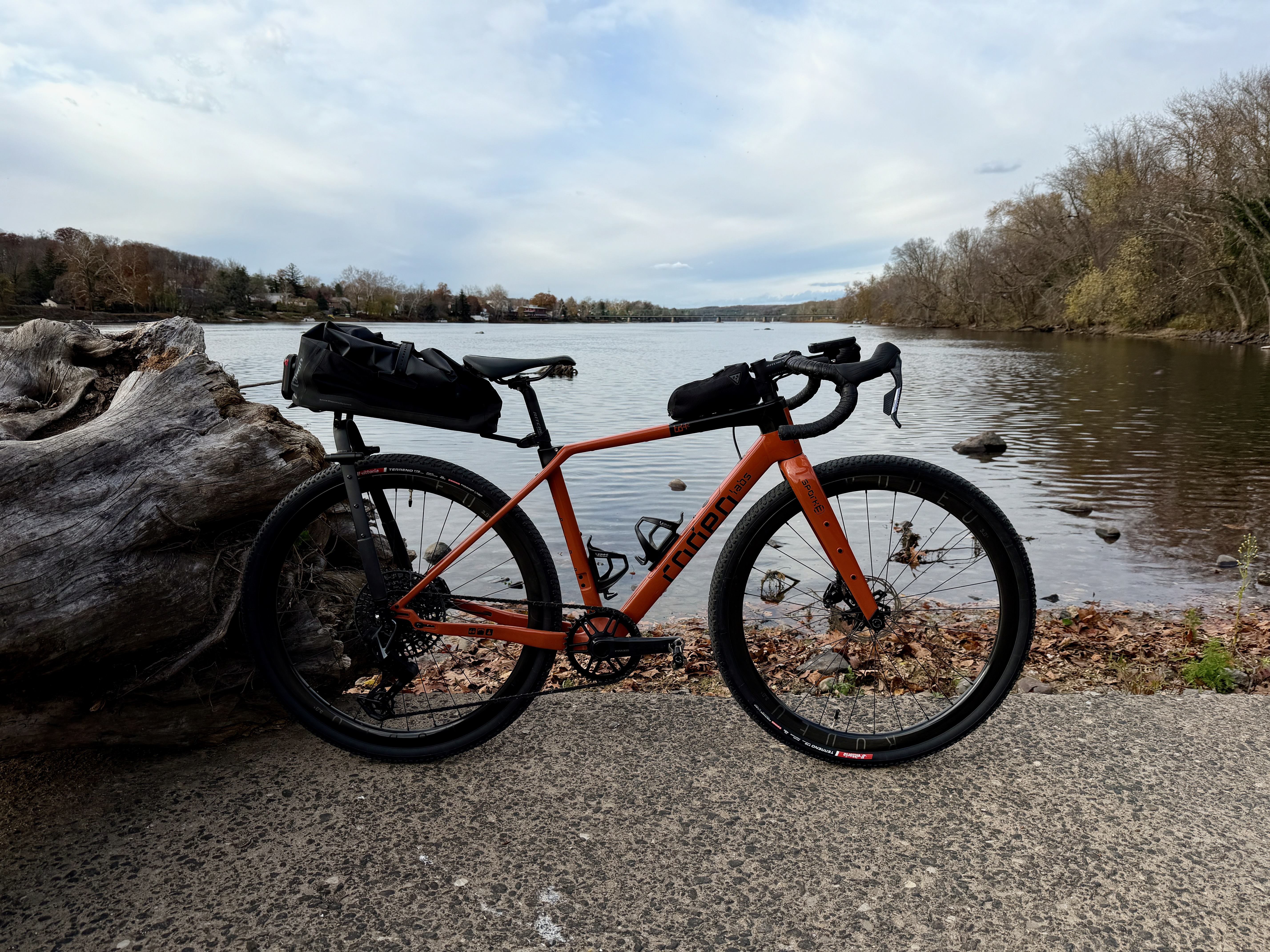
My Rodeo Labs Traildonkey with a Tailfin rear bag on it. Had not yet switched my 42T chainring over to a 36T for the trip.
The Gear Prep
I wish this part had been easier. I could have made it easier. Something in the back of my mind stops me from being free-wheeling enough to just YOLO a trip like this. I only had this opportunity once and I wanted it to be as good as I could make it. And so I plan and plan and plan again, making lists of thinking of all the negative outcomes I should be accounting for. The planning was absolutely more time than the trip itself. I think that’s important context to have as I explain this part of the adventure.
The Route Map. To start, I broke down Bikepacking.com’s VTXL route map into manageable chunks I thought I could handle each day. That landed me on a 7 day itinerary with some days as short as 45 miles and some as long as 90 miles and 10,000 feet of elevation. Perhaps those numbers are large enough to foreshadow what would be to come with the itinerary. Well, anyways.
The Tent. I already had a bikepacking-specific 2-person tent which was very nice (Big Agnes Copper Spur UL2), but at ~5 pounds there was substantial savings to be had if I could live in less of a palace. Google and Reddit led me to Dan Durston’s X-Dome tents. This would save me ~3 pounds of weight, and reviews told me this was an excellent tent. Fly-first pitch to help handle the elements, modern materials, and a shorty-pole set (carbon fiber, fancy!) perfect for packing up on a bike’s handlebars. I got on the wait-list and purchased from a drop they did in March. These tents are popular enough you have to plan ahead and buy right when new batches becomes available.
The Sleep Kit. Since this trip would be in the later summer months (July, North America) I knew a light-weight quilt would be better than my typical sleeping bag setup. A Sea to Summit Ember 45F quilt was chosen, because (1) I could get it from REI and (2) it seemed good enough. By the time I was researching sleeping bag upgrades, I had fatigued to the point of “I can’t invest another few hours into researching the best possible option here, so this seems fine.” Prior to buying the quilt, I had also upgraded my sleeping pad to a Big Agnes Rapide SL. This was a luxury, but one I was glad to have on my trip. I knew from a prior camping trip that I needed something a bit more comfortable to sleep on, and the VTXL trip was going to span ~8-9 days, so I had to prioritize comfort. Add a sleeping bag liner and an inflatable pillow to round out my sleeping kit.
Clothing. Here, I absolutely over-packed. I brought two pairs of cycling bibs and tops. Camp shorts and a merino wool t-shirt. A sun-hooding (never used). Four pairs of socks, of which I used only two (merino wool held up great). Swim trunks, which I did use multiple times. Sandals for camp, which had arch support and I am happy to have paid the weight penalty for this level of comfort. A rain jacket which was used heavily on the one day of rain I had and I’m thankful I brought it along. Wind pants. On the one hand, I packed for the worst case outcomes and I paid the weight penalty for that. On the other, I could have rolled the dice a bit more and lived with the consequences should the worst have come to pass.
Personal Supplies. Toothbrush, toilet paper, baby wipes. Staying in established campgrounds, I could have survived without bringing my own toilet paper – but it was nice to have just in case. Established campsites had showers, so baby wipes were not used often, perhaps just once in total. A toothbrush is a necessity when you spend all day eating carb-loaded foods to fuel the riding. But I could probably have cut back some items in this bag, too, as it was often filled with many items I dumped on the camp picnic table each night and then packed right back up without ever touching.
Tools. In case the bike broke. Multi-tool bit driver set, beam-style min torque wrench, dynaplugs, extra sealant, electric tire inflator, top-up wax and oil lube (just in case), extra SRAM AXS battery plus charger. Thankfully I never need to patch a tire or top up sealant, but I did adjust tire pressures every few days as air always finds a way out. This bag was heavy, but I did use many of the items in it each day. I could have removed a few safety net items, but the peace-of-mind might not have been worth the trade-off here.
Food. My smallest bag, as I knew I would be hitting many small towns with options to re-supply. I used country stores and gas stations to get sandwiches, water, soda, sports drinks, and lots and lots of candy and high-carb food items. Each day had at least two stops. My food bag contained a titanium cup and spork, plus some instant coffee and creamer for morning’s at camp. The coffee was a big quality of life improvement for basically no weight penalty.
Speaking of food, a cook kit was something I really debated bringing. So many small towns dotted the map, offering re-supply and food options, that it was silly to take up 1-2L of bag space and half a kilo on a camp stove. Many of my early training rides and camp outs told me that cooking at camp was nice, but not really required. However… this one piece of kit saw more use than most other things I brought.
First, coffee in the mornings really helped buoy my mood. Second, when my schedule didn’t work out as planned I had the option to (1) grab some instant food at a gas station along the way and (2) cook it at camp when I arrived and set up my tent. I might have done this more nights than not! Beans, rice, instant potatoes, ramen. All of these things were widely available, and helped ensure I could dedicate my evening hours to getting to camp and keeping my itinerary instead of worrying about where to get food or if my desired place would be open by the time I arrived. The trip would have been much worse without this small stove.
Packing List
A summary of my packing list:
- Bags
- Tailfin CargoPack
- Two Tailfin Fork Packs
- Tailfin Bar Cage + a random waterproof stuff sack
- Rogue Panda custom frame bag with 3L Apidura water bladder
- Small stuff sack for underside of Cargo Pack, mounted with mini Cargo Cage
- Silpoly stuff sacks to organize stuff
- Bike
- Tool bag
- Front light
- Rear light (Garmin radar RTL510)
- Blackburn Big Switch Ratchet Bike Multi Tool
- Bit driver extension from Prestacycle Pro T-Handle Ratchet Kit
- Prestacycle TorqRatchet PRO
- Gerber Dime
- Dynaplug tool
- Orange seal refill 2oz bottle (2x)
- Silca Drip Wax
- Silca Synergetic oil (as an emergency backup)
- Fumpa Mini Pump
- Fumpa pressure gauge
- Spoke repair kit
- Extra SRAM AXS battery
- SRAM battery charger
- 3L Apidura water bladder for frame bag
- Helmet
- Sunglasses (both clear and tinted set)
- Half-finger Gloves
- Fill-finger Gloves
- Wahoo ROAM bike computer
- Polar H10 heart rate strap
- Rear tail light safety strap (to avoid accidental fall offs)
- Chamois cream
- Lightweight cable lock
- Tool bag
- Clothing
- 2 cycling bib shorts (one merino wool, one synthetic)
- 2 cycling jerseys (one merino wool, one synthetic)
- 3 pairs socks, 1 wool, 1 long, 1 short
- Camp shorts
- Wind pants (thin ones)
- 2 boxers
- 2 t-shirts (one merino wool)
- Swim trunks
- Camp shoes from Z-Packs
- Warm hat for night sleep and cool mornings (didn’t use it)
- Albion Rain jacket
- Sun hoodie (didn’t use it)
- Camping
- X-Dome 1+ Tent
- X-Dome Tent Footprint
- Sleeping quilt Sea to Summit Ember
- Sleeping pad Big Agnes Rapide SL
- Sleeping bag liner (something generic off Amazon)
- Inflatable Pillow
- Head lamp Black Diamond Storm 500
- Various lengths of rope (Lawson’s Glowire)
- Bear ziplock bags
- Tenacious tape for repairs
- Food
- JetBoil Stove
- Starbucks Via instant coffee
- Creamers
- Snow Peak Titanium spork
- Snow Peak Ti-Single 450 titanium cup
- Hammer Enduralite powder
- Precision Fuel & Hydration 90g carb gels
- Can opener (the kind they gave soldiers)
- Water filtration kit
- CNOC 2L bag
- Sawyer squeeze
- Chemical sanitization tablets (backup if filter fails)
- Toiletries
- Camp Soap
- Toothpaste
- Toothbrush
- Deodorant
- Flossers
- Ibuprofen
- Baby wipes
- Toilet paper
- Baby powder for friction burn treatment
- PACT Outdoors Ultra Lite Bathroom Kit
- Culo Clean
- Collapsible 500mL water bottle (fits Culo Clean)
- Band aids + blister care
- Misc
- Cash
- Debit card
- Quarters for showers at camps
- AirPods
- Charging brick
- Anker Prime Power Bank (~25,000 mAh one that supports fast charging)
- Short USB C to charge head unit while riding
- Longer USB-C for everything else
- Sunscreen
- Bug repellent (Sawyer Picaridin)
- Camp towel
- Mini towel
- Plastic bags
- Gallon zip lock bags
- A rag
- Zip ties
- Trash bag (emergency water proofing)
- Two ROK straps
- Drone
- Carabiner clips