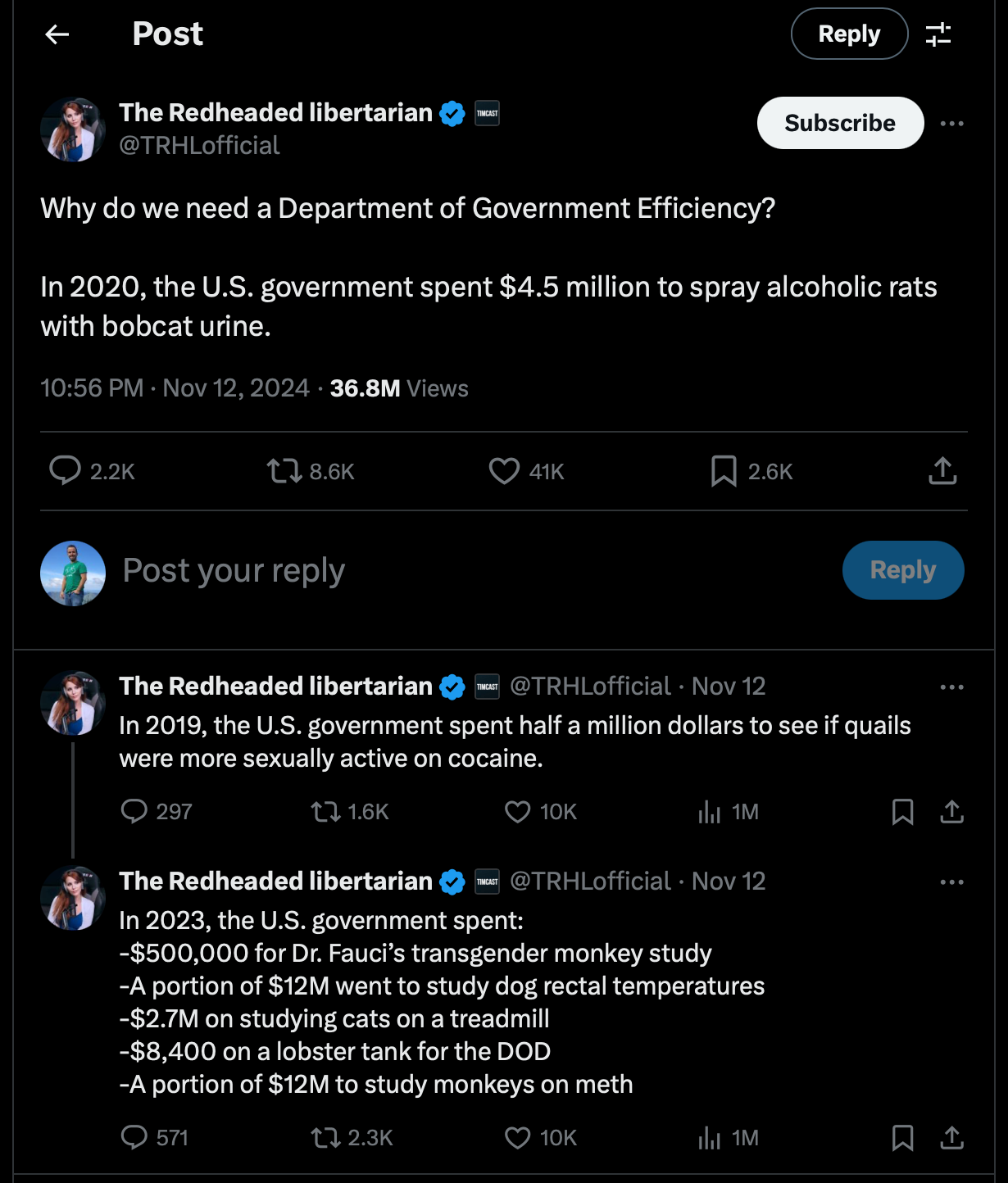
The claim: “In 2020, the U.S. government spent $4.5 million to spray alcoholic rats with bobcat urine.”
In just under 8 minutes, YouTuber Hank Green “does his own research”1 and finds:
- Bobcats are rat predators, which makes bobcat urine induce a stress response in the rats.
- Studying how a history of using (or abusing) alcohol is influenced by stress is relevant to the human condition.
- The neurochemistry of the relationship between PTSD and alcoholism is complicated.
It was funded by several National Institute of Health grants, hence the claim “the government spent $4.5 million on…”. Of course, it wasn’t some bureaucrat’s idea to spray rats with cat pee – it was the scientists who designed and executed the study. The funding came from the NIH but the ideas came from the broader scientific community.
What could this research be used for? Helping the many people living with both alcoholism and post-traumatic stress disorder, a large population of which would include veterans and service members. To some critics of wasteful government spending and supporters of a yet-to-be-created Department of Government Efficiency2 I suppose this use of government funds is suspect. But scientific discovery is not now, nor has it ever been, a straightforward path.
Did it really cost $4.5 million in 2020? No.3
In the words of Ted Lasso (and definitely not Walt Whitman)4…

Scare-quotes because Green does not call it “doing his own research.” For whatever reason, folks who seriously do their own research never refer to it as “doing their own research” – odd! ↩︎
The executive branch cannot create Departments. Only Congress can do that (see the Constitution, and how the DOT was formed). Even executive branch Offices require Congressional action, as did the Executive Office of the President setup in 1939. Perhaps next year we’ll see Congress take action on this; we did get a Space Force back in 2019, so anything is possible! ↩︎
The reference to “In 2020…” in that tweet is peculiar. You can see in the Acknowledgements section of the study that it was funded by NIH grants AA023696 (ALS), AA023305 (NWG), and AA026531 (NWG). The NIH website has a tool which allows you to search for grants and here’s what I found for AA023696 (ALS), AA023305 (NWG), and AA026531 (NWG). Some quick mental math shows only ~$700k in the fiscal year 2020 combined across all three grants. These three grants started funding as early as 2014, and run through at least 2024. Those grants seem to be in support of ~40 other studies, not just this one. So did the NIH really spend $4.5 million on rats and bobcat urine? No, it did not. ↩︎
Obligatory YouTube video link. ↩︎